
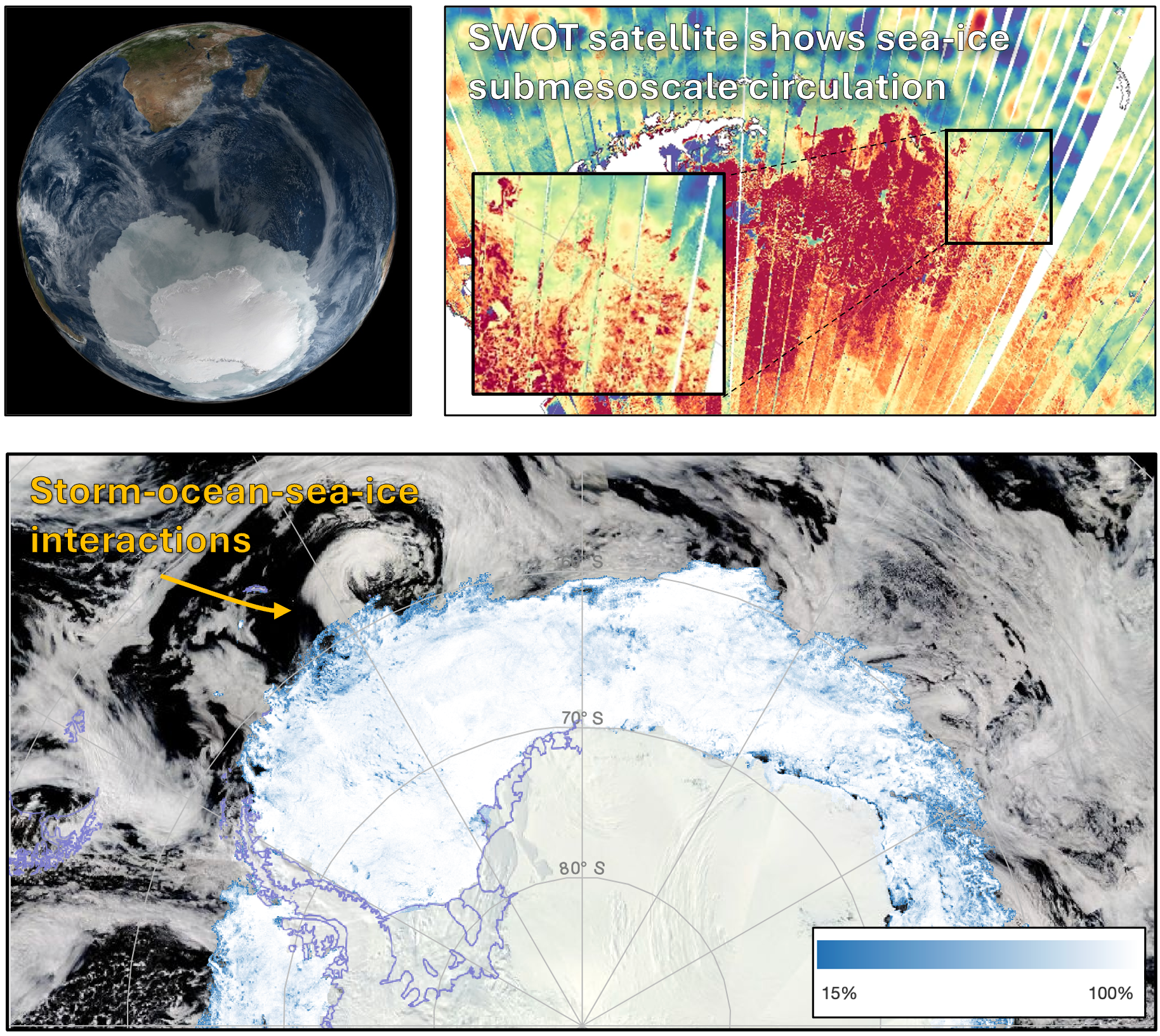

This project explores how storms affect the exchange of heat and carbon between the ocean and the atmosphere in the harsh and rapidly changing environment of the Southern Ocean. We want to understand how storms interact with small-scale ocean motions and sea ice to shape these exchanges and, in the process, improve the formulas used to describe them in climate models.
Our goal is to make climate projections more accurate by combining existing observations with new, cutting-edge measurements. Using data from the only year-round Southern Ocean Flux mooring, I’ll study how storms drive changes in ocean heat and carbon uptake from one season to the next.
I’ll also be part of the Pulse of the Weddell Sea Expedition, where we’ll deploy autonomous instruments such as Wave Gliders, Sailbuoys, and ocean-profiling gliders to measure how the ocean and atmosphere interact in icy regions. Working closely with international collaborators, these efforts will give us a rare, detailed view of ocean conditions during extreme weather events.
To complement these field observations, we’ll use high-resolution satellite data from the Surface Water and Ocean Topography (SWOT) mission, which provides unprecedented detail on ocean currents and sea ice patterns. Together, these tools will help us reveal how storms and small-scale ocean movements influence Earth’s climate system.
Finally, we’ll use what we learn to improve the models that simulate heat and carbon exchange between the ocean and atmosphere. By reducing uncertainty in how we represent these processes, we hope to strengthen future weather forecasts and global climate projections — and highlight the growing power of autonomous ocean observing systems.