Research
Fine-scale ocean dynamics
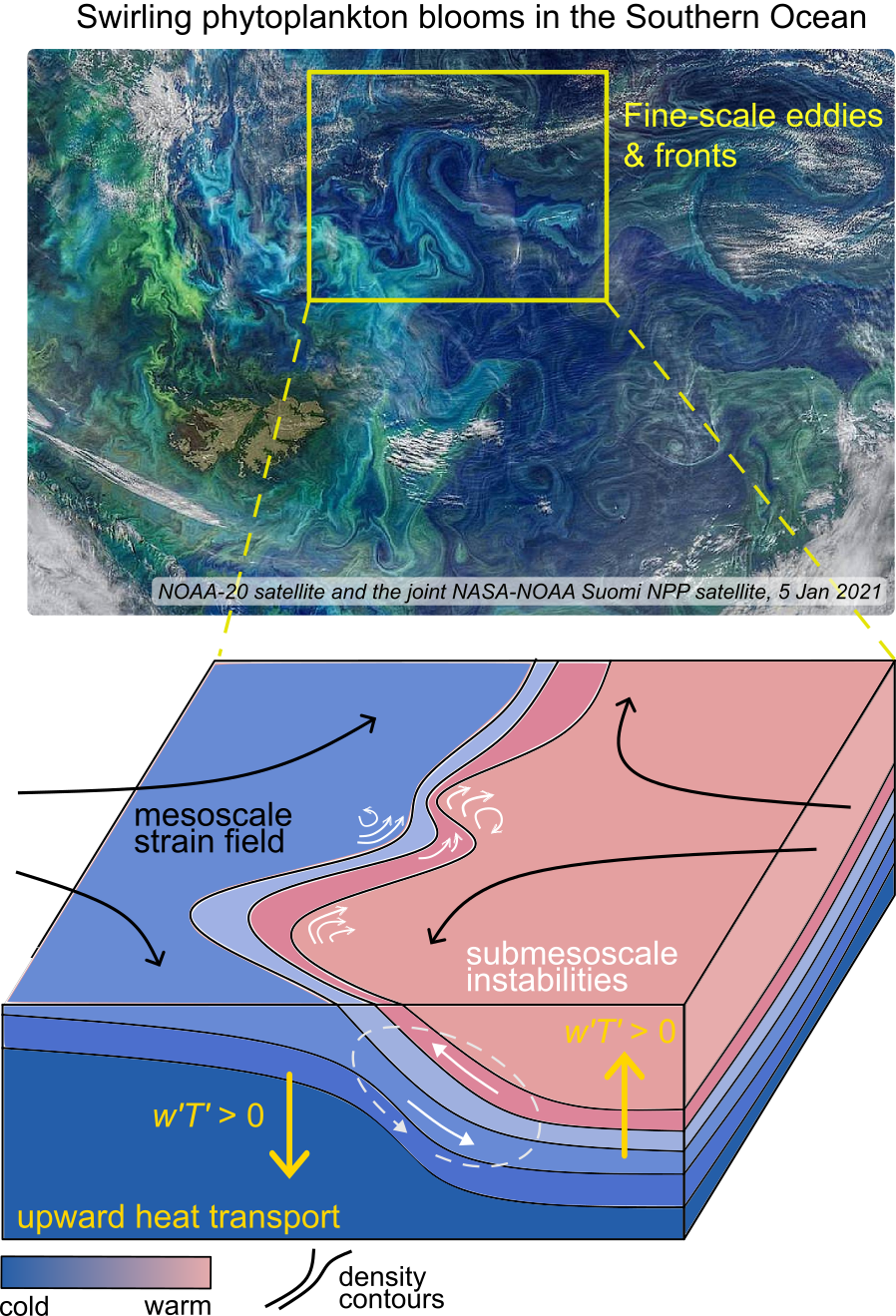
My research is primarily centered on fine-scale ocean dynamics, in particular the energetic fronts, filaments, and submesoscale eddies that are ubiquitous in the upper ocean, especially in the stormy Southern Ocean. These features are typically only a few to tens of kilometers wide, but they can extend hundreds of kilometers in length and penetrate hundreds of meters deep, where they stir and overturn water masses, sharpen density gradients, and drive vigorous vertical motions. When they do so, they strongly modulate air–sea exchanges of heat, moisture, and carbon dioxide, imprinting the passage of storms on the upper ocean and shaping the structure and variability of the ocean mixed layer.
Fine-scale fronts and filaments are numerous, collectively influencing how efficiently the ocean takes up anthropogenic heat and CO2, and how that uptake is distributed in space and depth. Biases in the representation of these small-scale processes in climate models can therefore lead to errors in simulated stratification, mixed-layer depth, and air–sea fluxes, with knock-on effects for large-scale ocean circulation and climate projections. To better understand and constrain these dynamics, I combine multi-platform observations from autonomous ocean robotics, research vessels, and satellites with high-resolution coupled models and boundary-layer frameworks.
Storm dynamics
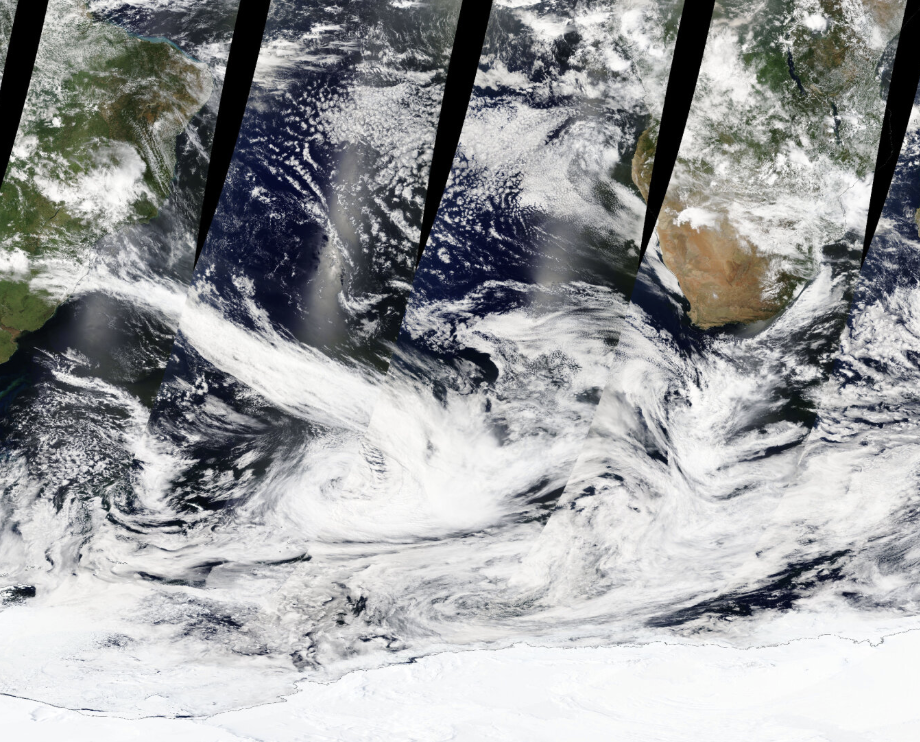
My research also focuses on storm dynamics, particularly how extratropical storms in the Southern Ocean mix and ventilate the upper few hundred meters of the ocean. As storms pass, their intense winds, rain, and rapidly evolving atmospheric fronts drive strong turbulent mixing, deepen the mixed layer, and tilt and sharpen ocean fronts, leaving behind vertical and lateral structure that can persist long after the weather has moved on. These episodic events strongly modulate air–sea exchanges of heat and carbon dioxide, imprinting high-frequency variability on fluxes that can integrate over seasons to influence the net uptake of anthropogenic heat and CO2 by the Southern Ocean.
Storm systems are frequent and energetic, especially in the high-latitude Southern Ocean, playing a disproportionate role in setting the seasonal cycle of upper-ocean stratification, sea-surface temperature, and surface CO2. Biases in how storms and their associated mixing are represented in models can therefore translate into errors in simulated air–sea fluxes and climate feedbacks. To investigate these processes, I combine targeted storm-following observations from autonomous platforms such as gliders and Wave Gliders with ship-based measurements, satellites, and mixed-layer and boundary-layer models that resolve the coupled evolution of storms and the ocean beneath them.
Current projects
I have recieved several grants and awards that support my research, with a total value of 40 million SEK. My ongoing projects include:
- European Research Council (ERC) Starting Grant Southern Ocean Fine-Scale Interactions with the Atmosphere (SOFIA), 2026-2031.
- Vetenskapsrådet (VR) Establishment Grant: Storm impacts on Southern Ocean heat and CO2 uptake uncertainty, 2025-2028.
- Carl Tryggers Foundation Grant: Observing and quantifying the effects of atmospheric storms on air-sea heat exchange, 2026-2028.

Southern Ocean Fine-Scale Interactions with the Atmosphere (SOFIA)
European Research Council Starting Grant under Horizon Europe, 2026-2031Funding: 2.5m € + 3.75m SEK as GU co-financing
The SOFIA project aims to uncover the key physical processes that move heat between the atmosphere, the ocean surface, and the deep ocean in the stormy Southern Ocean. My research explores two main questions: how powerful storms drive the exchange of heat between air and sea, and how swirling ocean fronts, eddies, and narrow filaments transport that heat into the ocean interior.
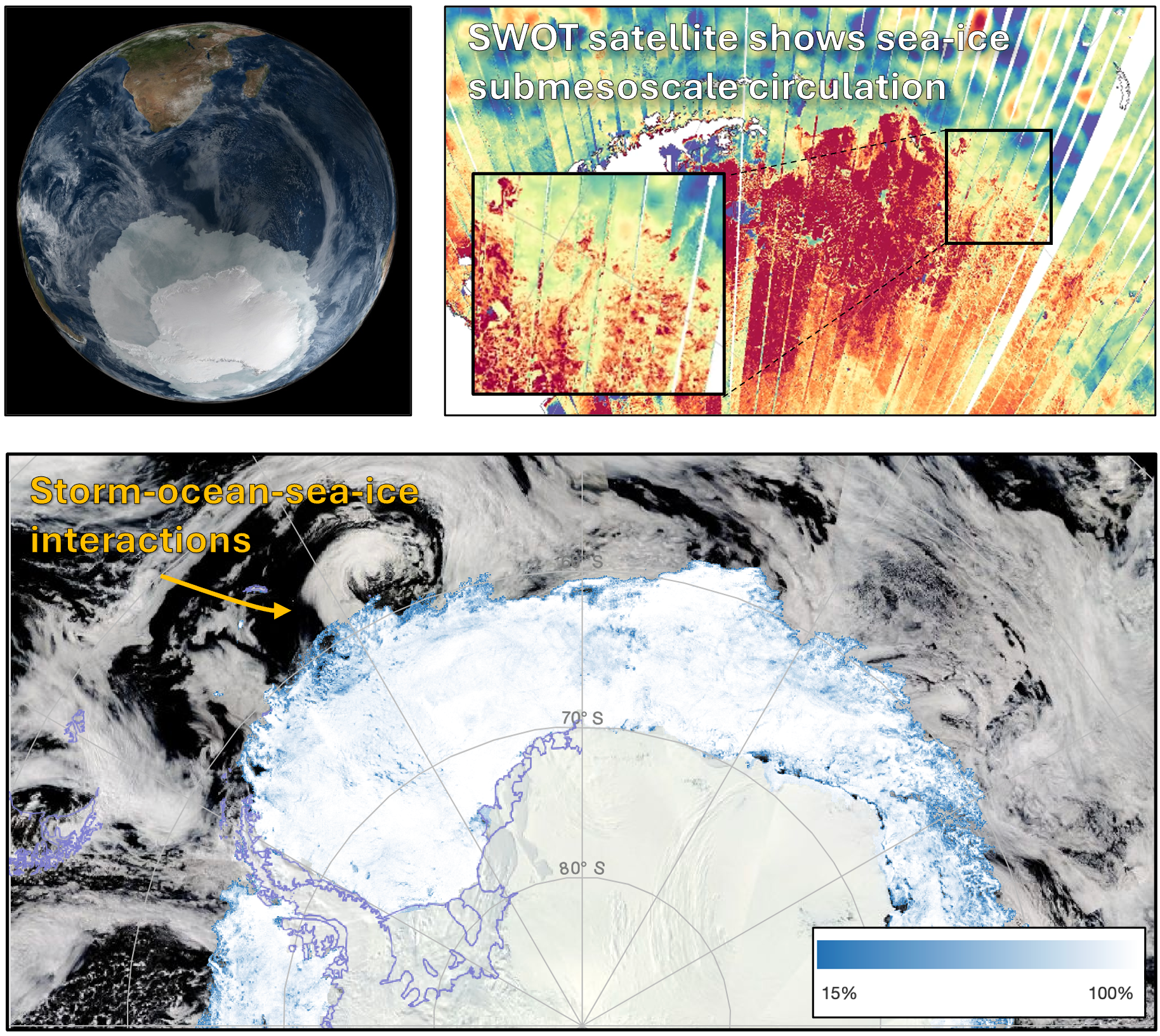
To tackle these challenges, I combine cutting-edge coupled ocean-atmosphere simulations with new in-situ observations collected by autonomous robotic platforms in one of the most remote parts of the planet. I also use data from ESA’s Surface Water and Ocean Topography (SWOT) satellite to map vertical ocean motion across the entire Southern Ocean.
Together, these efforts will build a clearer and more predictive understanding of how the ocean regulates Earth’s climate — knowledge that’s essential for improving future climate projections.

Storm impacts on air-sea heat and CO2 exchange uncertainty
Vetenskapsrådet (Swedish Research Council) Establishment Grant, 2025-2028Funding: 4.4m SEK
In my VR project, our goal is to explore how storms affect the exchange of heat and carbon between the ocean and the atmosphere in the harsh and rapidly changing environment of the Southern Ocean. We want to understand how storms interact with small-scale ocean motions and sea ice to shape these exchanges and, in the process, improve the formulas used to describe them in climate models.
Our goal is to make climate projections more accurate by combining existing observations with new, cutting-edge measurements. Using data from the only year-round Southern Ocean Flux mooring, I’ll study how storms drive changes in ocean heat and carbon uptake from one season to the next.
In this project, we will co-lead the Pulse of the Weddell Sea Expedition, deploying autonomous instruments such as Wave Gliders, Sailbuoys, and ocean-profiling gliders to measure how the ocean and atmosphere interact in icy regions. Working closely with international collaborators, these efforts will give us a rare, detailed view of ocean conditions during extreme weather events.

WHIRLS: The impacts of ocean fine-scale whirls on climate and ecosystems
PI's: Sebastiaan Swart (GU), Arne Biastoch (GEOMAR), Sabrina Speich (Ecole Normale Supérieure of Paris), Sarah Fawcett (University of Cape Town)
Call: European Research Council Synergy Grant, 2025-2030
Role: Research Scientist
WHIRLS takes place in an area called the Cape Basin, placed within the Agulhas Current System. This region has the strongest and most energetic currents in the world's ocean and play a key role in the global ocean circulation, and so strongly influences global climate. In particular, these currents 'leak' heat and salt from the Indian to the Atlantic Ocean, balancing the overturning circulation of the whole Atlantic and influencing the weather and climate we experience. I will work with Sebastiaan Swart and his research team together with biogeochemists, oceanographers, and climate modellers from France, Germany, and South Africa.
Completed Projects
Submesoscale Processes in a Changing Environment (SPICE)
PI: Marcel du Plessis
Call: Marie Skłodowska-Curie Individual Fellowship, 2021-2023
Funding: 2.3m SEK
Submesoscale Processes in a Changing Environment (SPICE) aims to quantify the variability of heat and carbon air-sea fluxes in the Southern Ocean and better understand how ocean submesoscale processes modulate heat and carbon exchange between the atmosphere and the ocean interior. In this project, I deployed a series of autonomous ocean vehicles called Seagliders and Sailbuoys alongside ship-based air-sea flux measurements to reveal how the ocean and atmosphere exchange heat and carbon at scales from hours to days.
Southern Ocean Carbon and Heat Impact on Climate (SO-CHIC)
PI: J.B. Salleé
WP Lead: Sebastiaan Swart (University of Gothenburg)
Role: Postdoc
Call: European Commission Horizon 2020, 2019-2025
Southern Ocean Carbon and Heat Impact on Climate (SO-CHIC) contributes to reducing uncertainties in climate change predictions, 16 institutions decided to pool ability in a common initiative and send in August 2018 a proposal to the call LC-CLA-08-2018 “Addressing knowledge gaps in climate science, in support of IPCC reports” as part of the European Union’s Horizon 2020 research and innovation programme. Our role in SO-CHIC is to investigate the impact of the physical processes which control the variability of heat and carbon uptake in the Southern Ocean. To do this, we quantify their fluxes at the air-sea-ice interface and estimate the synoptic-to-interannual variability of heat and carbon storage in the Southern Ocean.